A Dehumidifier for a Raleigh Crawl Space: Sizing, Drainage, Cost
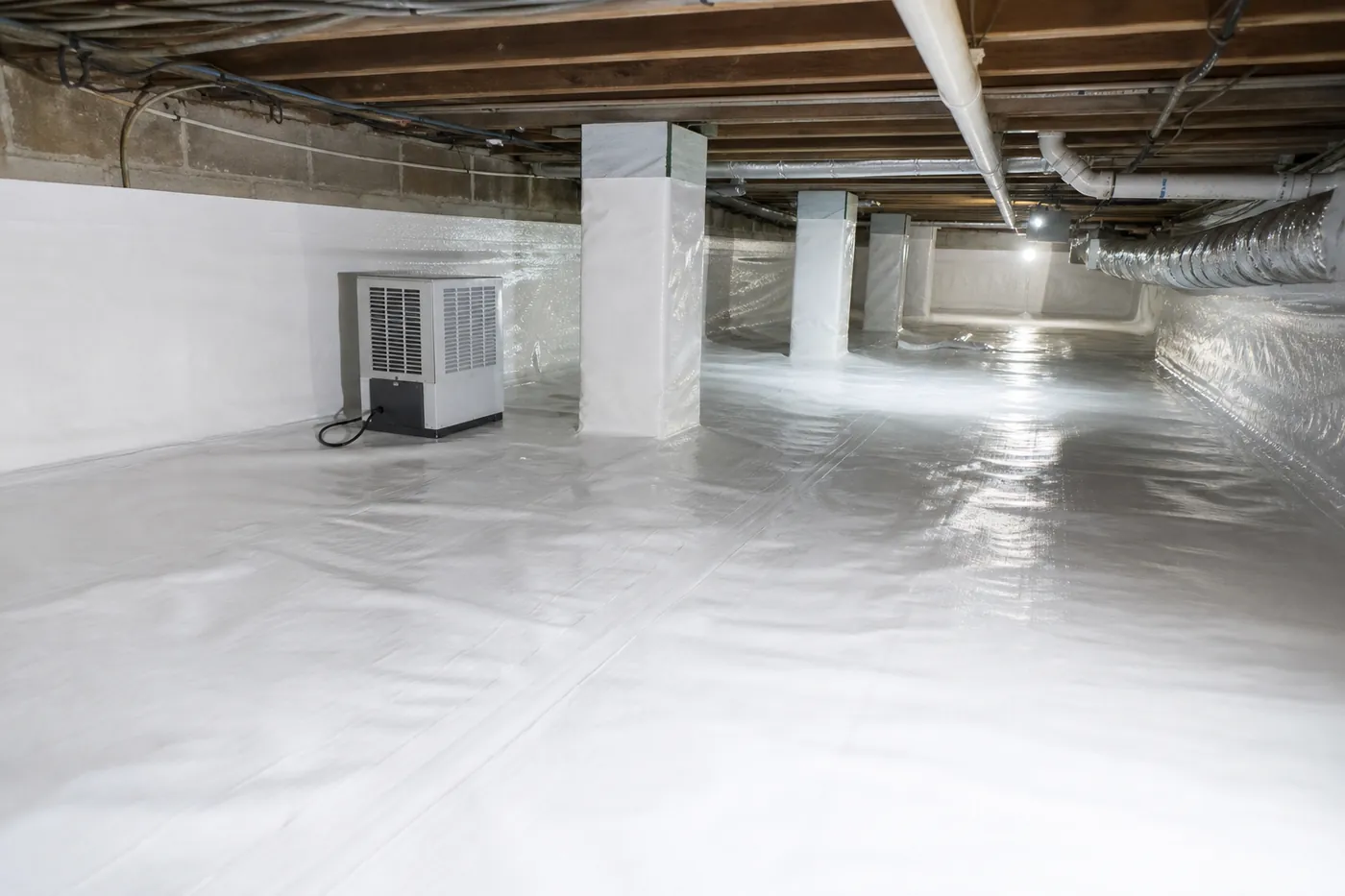
Once the vents are closed, something has to pull water out of the air under the house. In most sealed Raleigh crawl spaces that job falls to a dedicated dehumidifier, and a few details decide whether it does it well.
This Old House (2026) puts a crawl space dehumidifier, installed with wiring, at $800–$2,000; Fixr (2025) lists $750–$1,700. North Carolina's closed crawl space code calls for a permanently installed unit with a drain or condensate pump and an electrical outlet.
How is a crawl space dehumidifier different from a portable one?
A portable dehumidifier with a bucket fills up, shuts off and waits for someone to empty it, and few people crawl under the house every other day to do that. Crawl space models are built to run in cool, damp air, sit on a pad or hang from the joists, and empty themselves through a hose or pump. They also tend to be ducted so dry air reaches the far corners rather than one patch near the unit.
What a Raleigh summer asks of the machine
The load comes from two directions. Outdoor air is the first: averaged from NOAA's 1991–2020 hourly normals at Raleigh-Durham International Airport, the dew point is 68.7°F in July and 67.8°F in August, and some of that air leaks in around doors, plumbing holes and rim joists even after the vents are closed. The soil is the second, because the ground under a liner is never fully cut off.
The code text the fire marshal's office excerpted from the 2012 edition set a minimum of 15 pints a day; ask the specialist what the current edition requires. Either way, a minimum is not a sizing method. Ask the specialist how they picked the capacity, what humidity they plan to hold (many aim to keep the crawl space below about 60%), and whether the unit has a built-in humidistat you can read without crawling in.
Where does the water go?
North Carolina's code wants the condensate carried away by a drain or a condensate pump. A gravity line is simplest where the lot slopes away from the house; a pump is needed where it doesn't. If a pump is used, ask whether it has an overflow alarm or shut-off, because a failed pump puts water right back on the liner. The unit also needs an electrical outlet, which may mean an electrician.
Permits and licenses
The NC Office of State Fire Marshal, relaying the plumbing and heating licensing board, lists the dehumidifier method as one that does not require an H-3 heating license, unlike ducted supply air from the house system. Electrical work can carry its own licensing, and converting a vented crawl space to a closed one needs a permit regardless of cost. To see how the unit fits into the whole job, compare it with the line-by-line encapsulation price ranges.
Questions homeowners ask
Can supply air from my AC replace a dehumidifier?
It's one of the five drying methods North Carolina's code allows: conditioned air ducted in from the house system. The fire marshal's office notes this method needs an H-3 heating license. Whether it keeps humidity low enough in July depends on how much the system runs.
Sources
- NOAA NCEI 1991-2020 hourly normals, Raleigh-Durham International Airport (dew point)
- NC Office of State Fire Marshal: closed crawl space moisture control, permitting and H-3 licensure (2019)
- NC Office of State Fire Marshal: closed crawl space moisture control, 2012 code excerpt
- NC Office of State Fire Marshal: permit required for a closed crawl space (Dec. 11, 2025)
What's going on under your floor?
Tick the closest match and add a sentence about what you've noticed: a smell, sagging insulation, water after storms. A crawl space specialist who works in Raleigh phones you to go over it.